

Peptide Bioregulator Education
How Peptide Bioregulators Work: Cellular Communication, Tissue Specificity & Healthy Aging
Aug
How Peptide Bioregulators Work: Cellular Communication, Tissue Specificity, and Healthy Aging
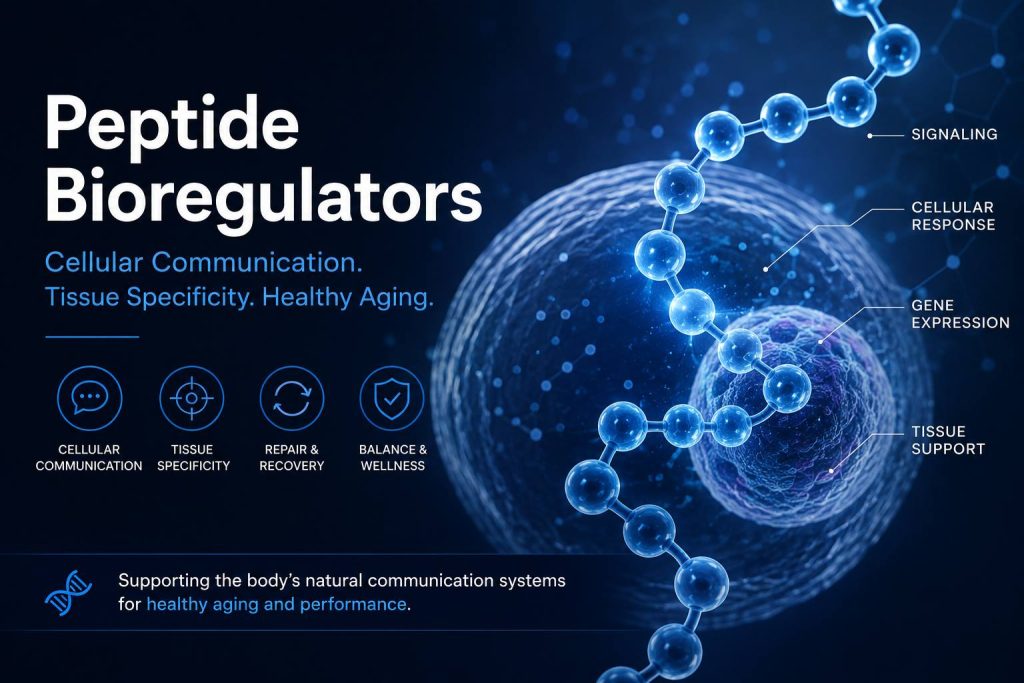
Peptide bioregulators are short chains of amino acids studied for their potential role in biological signaling and tissue-specific regulation. Their scientific interest comes from how small peptide sequences may interact with cellular processes involved in normal function and healthy aging.
What Is a Peptide Bioregulator?
Peptides are short chains of amino acids. Amino acids are also the building blocks of larger proteins, but short peptides can perform very different biological roles.
Some peptides participate in cell signaling, helping transmit information between cells and tissues. Peptide bioregulators are studied within this broader area of peptide biology because certain short peptide sequences have been associated with particular tissues and physiological systems.
This is one of the concepts that separates peptide bioregulators from ordinary nutritional ingredients. Instead of being viewed simply as nutrients or building blocks, peptide bioregulators are studied primarily for their potential role in biological communication and regulation.
Think of Peptides as Biological Messages
Traditional nutrients primarily provide materials the body can use. Peptide bioregulators are studied as short signaling molecules that may interact with cellular systems involved in normal tissue function and regulation.
Why Cellular Communication Matters
The human body contains trillions of cells. For those cells to operate as one coordinated biological system, they must continuously exchange information.
Cells receive signals related to energy production, protein synthesis, normal repair processes, immune activity, metabolism, adaptation to environmental stress, and countless other functions.
Peptides are one of several classes of molecules involved in this communication network.
What makes peptides especially interesting is their size. Even relatively short sequences of amino acids can carry biological information and participate in highly specific molecular interactions.
Cellular Signaling
Peptides can participate in the molecular signaling networks cells use to exchange biological information.
Tissue Relationships
Certain peptide sequences have been investigated for relationships with particular tissues and physiological systems.
Biological Balance
Researchers continue investigating how short peptides interact with mechanisms involved in normal cellular regulation.
What Does Tissue Specificity Mean?
Different tissues in the body perform completely different jobs.
Liver cells function differently from nervous-system cells. Vascular tissue has different responsibilities from immune tissue. Each tissue has its own characteristic patterns of receptors, enzymes, proteins, and gene activity.
Because of these differences, biological communication must be remarkably organized.
Research into peptide bioregulators has explored whether particular short peptide sequences demonstrate relationships with specific organs, tissues, or physiological systems.
This concept is generally referred to as tissue specificity, and it is central to understanding the philosophy behind peptide bioregulators.
Peptides and Gene Expression
Nearly every cell in the human body contains essentially the same genetic blueprint. Yet a skin cell behaves very differently from a liver cell, muscle cell, or neuron.
One reason is gene expression.
Gene expression describes the process through which cells use information contained in DNA to produce proteins and perform specialized functions.
Research involving short peptides has investigated possible interactions with cellular processes associated with gene expression, protein synthesis, chromatin, and other regulatory mechanisms.
This does not mean peptide bioregulators rewrite DNA. The scientific interest involves how signaling molecules may interact with mechanisms that determine how existing genetic information is expressed and used by cells.
Why Peptide Research Is Connected to Healthy Aging
Aging is not caused by one single biological change. It involves many interconnected processes occurring throughout cells, tissues, and organs.
As the body ages, changes can occur in mitochondrial function, cellular signaling, protein production, antioxidant defenses, immune activity, tissue maintenance, and responses to biological stress.
Researchers studying healthy aging are therefore interested not only in individual nutrients but also in the communication systems responsible for coordinating cellular activity.
Because peptides can participate in signaling pathways, peptide biology has become one area of interest within the larger field of aging research.
Maintaining Function Matters
Healthy-aging research is not simply about lifespan. An important goal is understanding how the body can maintain normal cellular communication, energy production, tissue function, resilience, and physiological balance throughout life.
Peptide Bioregulators vs. Traditional Supplements
Traditional dietary supplements commonly contain vitamins, minerals, amino acids, fatty acids, plant extracts, and other nutritional ingredients.
These compounds generally provide nutrients or substances that participate in normal physiological processes.
Peptide bioregulators represent a different scientific concept. Their primary interest comes from their potential role as signaling molecules rather than simply as sources of nutrition.
| Traditional Supplements | Peptide Bioregulators |
|---|---|
| Primarily provide nutritional compounds | Studied primarily as signaling compounds |
| Often provide broad nutritional support | May demonstrate relationships with particular tissues |
| Vitamins, minerals, herbs, amino acids and other nutrients | Short sequences of amino acids |
| Nutritional support is generally the primary purpose | Scientific interest centers on communication and regulation |
Vladimir Khavinson and Peptide Bioregulator Research
Much of the modern discussion surrounding short peptide bioregulators is associated with Professor Vladimir Khavinson and his colleagues.
Khavinson’s work investigated short peptides in connection with aging biology, tissue-specific regulation, protein synthesis, and gene-related cellular processes.
This research helped bring attention to an important idea: extremely small peptide sequences may have biological roles extending beyond simply being components of larger proteins.
Instead, some short peptides may participate in regulatory and signaling processes.
Why Can Such Small Peptides Be Important?
In biology, size does not necessarily determine importance.
A relatively small molecular sequence can still interact with receptors, enzymes, proteins, membranes, or other components of cellular systems.
This is one reason short peptides are particularly interesting to scientists studying cellular communication.
Researchers can investigate individual peptide sequences and examine whether their structure is associated with specific biological interactions.
The Bigger Picture: Your Body Is a Communication Network
Nutrition is essential, but human biology involves much more than simply supplying cells with raw materials.
Cells must know what to do with those materials.
They must communicate, respond to signals, manufacture proteins, regulate energy production, react to changing conditions, and coordinate their activity with surrounding tissues.
This communication network is one of the reasons peptide science is so fascinating.
Peptide bioregulators are being studied within this larger biological framework: not simply as amino acids, but as short sequences that may carry information within complex cellular systems.
Peptide Bioregulators Are About Biological Communication
The central concept behind peptide bioregulators is signaling. Rather than functioning only as nutritional building blocks, these short amino-acid sequences are studied for their possible relationships with tissue-specific cellular communication and normal biological regulation.
Continue Learning
Learn about the researcher whose work became closely associated with the development of peptide bioregulator science:
Explore Vladimir Khavinson’s Research →
For practical product context, explore the peptide bioregulator collection. You can also explore additional educational articles in the Origin BioRegulators Blog .
